Total Pageviews

Tuesday, November 20, 2012

Getting Ready for Winter

Blizzard of 2011 (Tichigan Lake)
While this photo may seem extreme, it is a reminder that those cold, blustery days are right around the corner.  Just about the same time that you turn your bird baths upside down for the season, you should be thinking about a fresh water alternative for your Winter birds!

You don't want to wait until it is 20 degrees or colder to drag out your heated birdbath. Get it set up and ready to go as the temperatures dip below freezing at night. Having an accessible water source is extremely important for wild birds, especially in the northern climates.  Even though we are surrounded by water here on our peninsula, the marsh and lake will soon be frozen, and it will be difficult for birds to get the open water they need.

Once you get your Winter birdbath set up, don't forget to keep your feeders filled. Like anything else, it is easier and much more enjoyable to be outside when the temperatures are warm.  However, the birds have fewer natural food resources in the winter, so it is important to maintain your feeders...especially during severe cold snaps.

The platform feeder above is mounted on my deck, and is within a few steps of my patio door.  Even when the snow piles up, I can easily maneuver my way to deposit fresh seed.  If you are not already offering suet at your feeding stations, Winter is a great time to do so.  Suet provides "high-energy" nutrition at a critical time of year.

I enjoy feeding the birds year round.  However, there is something about sitting with a cup of coffee on a cold, snowy day and watching the birds that gives me a real sense of comfort.

Happy Birding!

Belinda's Website


Tuesday, October 30, 2012

Looking for Loons

Common Loon (Non-breeding Adult)
Today I caught a glimpse of five Common Loons as they made a migration stop on Tichigan Lake. While the conditions were not conducive for taking a good photograph, I recognized their unmistakable profiles despite their Fall plumage. See photo (left) courtesy of Cornell Lab of Ornithology

These icons of the Northwoods are easy to ignore this time of year because they have lost their distinguished black and white markings and taken on a less dramatic appearance.  However, careful observation of their shape and graceful swimming style will quickly help make a positive identification.

Have you ever wondered where these "snowbirds" go to spend their winter months?  You may be surprised to learn that like many of us, they choose to hang out along the warm coastal waters of the United States.  If you are planning a trip to a warmer oceanside location this winter, keep an eye out for loons.  Despite the fact that they do not put on a vocal performance like they do during the breeding months, there is still something mesmerizing about viewing these elegant creatures as they move through the water.

For more information on Common Loons, visit this link at the Cornell Lab of Ornithology Common Loon.


Belinda's Website


Tuesday, October 9, 2012

Send Squirrels Packing with Safflower


Gray Squirrel
I don't have to tell anyone who regularly feeds the birds what a challenge it can be dealing with squirrels.  The constant battle to keep these critters from emptying your bird feeders can drive almost any bird enthusiast insane.

Fortunately, I have discovered that I can turn almost any type of bird feeder into a squirrel-proof feeder by simply providing safflower seed, as opposed to offering black oil sunflower or a bird seed mix.

Safflower is known as one of man's earliest crops, and has had various culinary, cosmetic and medicinal uses throughout history.  In recent years, it has gained favor among individuals who enjoy backyard bird feeding. While being a favorite meal among "desirable" birds, including cardinals, chickadees, grosbeaks and nuthatches, squirrels do not particularly care for its taste.

If you have a favorite feeder that has become a victim of regular squirrel raids, try replacing what you are currently feeding your birds with "straight" safflower.  I have done this in all the feeders in my yard that are not currently squirrel proof. They are frequented regularly by my favorite birds, while the neighborhood squirrels pay them no attention at all.

In addition to being a deterrent to marauding squirrels, the bright white seed also adds a nice aesthetic touch when filled in a decorative feeder.  Safflower can take the place of any seed you are currently using in a fly-through, hopper or tube feeder.

Give it a try and pick up a bag of safflower the next time you need fresh bird seed. It will save you money in the long run and might just become your "new" favorite as well!
Safflower Seed


Note:  Use of safflower is not 100% squirrel proof, as some squirrels may eat it on occasion.

Belinda's Website


Friday, September 28, 2012

Missed Opportunities

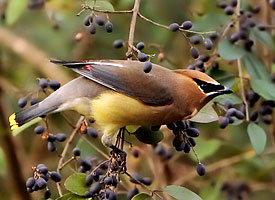
Cedar Waxwing
I would like to take credit for this awesome photo of a beautiful Cedar Waxwing, but unfortunately I cannot.

Yesterday, I had the pleasure of having a flock of Cedar Waxwings converge on my yard and crowd the birdbath on my deck.  I knew immediately what was happening, as I saw the telltale signs of a waxwing flock.  My cedar tree was filled with birds, and the limbs were moving as if the tree were actually "alive".  I peered out the window onto my deck and saw a half dozen waxwings enjoying my birdbath.

What's wrong with this scenario?  After realizing that I had a wonderful opportunity to capture some great photos, I discovered that both batteries for my Olympus camera were dead!  I couldn't get a single shot off.  By the time I loaded a battery into the charger, and had it sufficiently charged...the Cedar Waxwing flock had moved on.

I advocate that bird watchers should always have a camera handy should that elusive "bird" moment arrive.  I guess I need to remind birders to also make sure you have fully charged batteries in "said" camera.

While I missed what was most likely a "once-in-a-season" opportunity, I have learned a very important lesson.

For more information on this fascinating species, check out Cedar Waxwings at the Cornell Lab of Ornithology website @ Cedar Waxwing.

Belinda's Website


Tuesday, September 4, 2012

Wild Birds as Therapy

Indigo Bunting
Sometimes life throws us an unexpected curve ball. Whether you find yourself facing a sudden job loss, serious illness or the death of a loved one, making time for the birds can be an unexpected source of comfort.

When you are feeling as though your world as been turned upside down, establishing a connection with nature during troubling times can keep you grounded.  There are numerous studies to support the fact that viewing and/or feeding wild birds can provide calming health benefits as well.  Simply taking a few minutes each day to fill your feeders and/or to identify different bird songs is quite therapeutic.

If you haven't already started the "addicting" habit of birding, it's not too late to start.  Sharing your hobby with those who may benefit from it is a wonderful way of giving comfort in their time of need.  There are plenty of inexpensive feeder options that can provide for maximum success and enjoyment.  Most independent lawn and garden centers have staff on hand that can create a "starter kit" to give as a gift.  They can help you determine what type of feeder/bird seed is most appropriate for their location and can also assist you with any bird guides for their area.  If a bird feeder is not desired, the garden center can also suggest a birdbath or flowers, trees and shrubs suitable for attracting birds.

Sharing the gift of birding, while beneficial to the human recipient, also helps provide for our feather friends as well!

Happy Birding!!!

Belinda's Website


Tuesday, June 19, 2012

The Heat is On

 Ruby-Throated Hummingbird

The heat is on, and it is the perfect time to remind bird lovers that they need to maintain their hummingbird feeders. When the temperatures rise up above the 80 degree mark, the nectar in feeders can quickly go bad.  When it gets this hot, I recommend cleaning and refilling feeders every 3-5 days, especially if they are hanging in an area with full sunlight.

If you don't have time to get to the store and purchase the powdered or pre-mixed nectar, you can make your own at home with sugar and water.  I use a 4:1 ratio of water/sugar:


I boil the water first in the microwave, then add the sugar until it dissolves.  I let it cool a bit on the counter then add it to an empty 1/2 gallon milk jug. This will stay fresh in your refrigerator for up to two weeks.

It is not necessary to have red coloring in the nectar as shown at left, especially if there is enough red visible on the feeder itself.

Keeping their feeders clean and filled with fresh nectar will ensure that your hummingbirds hang around throughout the "Dog Days of Summer".


Hummingbird Fun Fact:
The oldest known Ruby-throated hummingbird was 9 years 1 month old.

Belinda's Website


Monday, June 4, 2012

Water for Birds

Fountain Water Source
As the summer temps continue to rise, it is vital that we provide a source of water for the feathered friends we have managed to lure into our yard.

There are any number of ways to make water available, including the simple bamboo fountain shown here.  I took a beautiful glazed ceramic pot and attached it with clear silicone to the matching dish. This solved the issue of closing the drainage holes at the bottom of the pot.  I had purchased the bamboo spout (with pump) a few years ago at a local garden center.  I filled it with a few rocks, and it was ready to go.  Not only do the birds love it, but it provides a nice source of water for my two dogs and cat.

The sound of gently-flowing water is irresistible to both birds and other wildlife. However, I don't limit myself to just one fountain.  In fact, I have an additional six (yes six) birdbaths located throughout my yard.  Not only do they provide a needed drink and/or bath for birds frequenting my bird feeders, but it is often visited by those "elusive" woodland species who prefer to dine on fruits and insects.  Placing a water source close to the edge of a wooded area is a great way to see a variety of species, including wood warblers.

Re-purposed Birdbath
Don't be afraid to get a little creative...this birdbath (left) was a favorite last season for my robins and blue jays to bathe in.  It was made from a combination of repurposed items (old glass light fixture shade and iron candlestick).  If you are not particularly creative, your local garden center will have a variety of birdbaths and/or fountains for you to choose from.

Don't forget to keep them clean and filled with fresh water.  You can also treat your birdbaths and fountains with special "safe" enzymes to keep the water clear and fresh!

If you don't have to the time or money to spend endlessly filling bird feeders with seed or you don't care for the mess...try placing a few birdbaths in your yard today!


Belinda's Website